
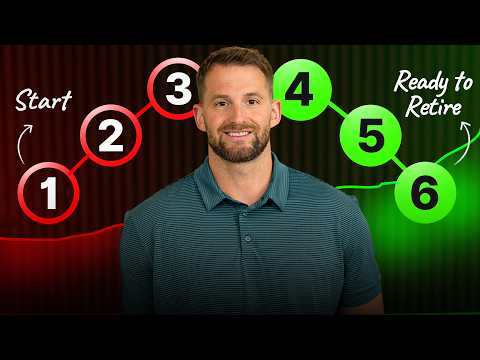
Waiting for Lower Taxes Before Converting to Roth? That's the Problem.

Key Takeaways
- Waiting for a "lower bracket" in retirement is usually the wrong assumption for couples with $2 million or more in pre-tax accounts.
- RMDs, Social Security, and IRMAA surcharges stack onto the same tax return and can push your blended rate higher, not lower, later on.
- At least nine specific tax surprises catch retirees off guard once RMDs and Social Security start layering together.
- The Golden Window, the years before RMDs and Social Security begin, is when your taxable income may be at its lowest point.
- Converting during that window can protect a surviving spouse from the widow's penalty, a permanent bracket squeeze after the first spouse passes away.
You've built $2 million or more in your 401(k)s and IRAs. Uncle Sam has a claim on every dollar. Your plan is to wait until retirement, when your income drops, and convert to Roth at a lower tax rate.
That plan is the problem.
In this guide, you'll see:
- Why the "lower taxes later" assumption breaks down for $2 million or more in pre-tax accounts
- Nine specific tax surprises that catch retirees off guard
- What the Golden Window is and why it closes
- How the Rothification Method™ builds a multi-year conversion plan
Let's get into it.
Table of Contents
The "Lower Taxes" Assumption
The assumption is simple. Your income falls in retirement. Your tax bracket drops. You convert to Roth at a lower rate. You pay less to Uncle Sam.
The assumption is wrong for couples with $2 million or more in pre-tax accounts.
| Scenario | What You Expect | What Often Happens |
|---|---|---|
| Wait to convert until retirement | A lower tax bracket | RMDs, Social Security, and IRMAA stack into a higher blended rate |
| Convert during the Golden Window | Paying tax now at a known rate | You fill your bracket deliberately and avoid the future stacking effect |
What Happens When You Wait
Your pre-tax balance keeps growing. Your investments compound. But so does the tax problem attached to every dollar.
Required minimum distributions start at age 73. If you were born in 1960 or later, that age moves to 75. Either way, RMDs force taxable distributions whether you need the money or not. The bigger your pre-tax balance, the bigger those forced distributions.
Social Security lands on the same tax return. Your provisional income goes up. More of your Social Security becomes taxable. IRMAA surcharges kick in when your modified adjusted gross income crosses certain thresholds. You pay more for Medicare Parts B and D.
Your surviving spouse files as single. Same income, higher tax brackets. The widow's penalty is real, and it's permanent.
Every year you wait, the pre-tax balance grows. The RMD gets bigger. The conversion cost goes up. The window to convert at a lower rate shrinks.
This is exactly the kind of tax exposure a retirement tax plan is built to catch before it compounds.
Nine Tax Surprises That Catch Retirees Off Guard
Waiting doesn't just cost you a lower bracket. It exposes you to surprises most retirees never see coming until the bill shows up.
IRMAA hits two years later. Convert big this year, and the Medicare premium surcharge shows up two years from now, based on this year's income. By the time you see it, the year that caused it is long gone.
Up to 85% of your Social Security gets taxed. Social Security isn't automatically tax-free. Once your income crosses the threshold, up to 85% of your benefit counts as taxable income.
Provisional income counts money you thought was tax-free. Municipal bond interest still counts toward the formula that decides how much of your Social Security gets taxed. Tax-free to the IRS isn't the same as invisible to the formula.
RMDs stack on top of Social Security, not instead of it. Both income streams land on the same return in the same year. Combined, they can push you into a bracket you didn't plan for.
One RMD can trigger three tax hits at once. A single forced distribution can raise your ordinary tax bracket, your Social Security taxation, and your Medicare premium, all in the same filing year.
Your state taxes the Roth conversion too. Federal isn't the only bill. Many states tax the full conversion amount as ordinary income in the year you convert, with no special break for retirees.
The Net Investment Income Tax follows you into retirement. Cross the income threshold and your dividends, interest, and capital gains face an extra 3.8% surtax, on top of your regular rate.
A large conversion can trigger an underpayment penalty. Convert late in the year without adjusting your withholding or estimated payments, and the IRS charges a penalty for paying too little too late.
Capital gains stack on top of ordinary income. A large Roth conversion can push your long-term capital gains out of the 0% bracket and into the 15% bracket, even though the gains themselves never changed.
This is why a conversion plan needs to look at your full tax picture, not just the current year's bracket.
The Golden Window
The years before RMDs and Social Security start are your lowest tax bracket. Not retirement. Not later. Now.
This stretch of years is called the Golden Window. It's the time when your taxable income could be lower than it will ever be again.
During the Golden Window, you convert to Roth in chunks. You fill your current tax bracket to the top. You pay the tax on the conversion amount. You repeat each year.
The Roth balance grows tax-free. The pre-tax balance shrinks before RMDs start. You keep more of what you built.
What Converting Now Actually Does
- Reduces the pre-tax balance before RMDs force taxable distributions
- Fills your current bracket instead of a higher one later
- Creates tax-free growth outside the RMD system
- Protects your surviving spouse from the widow's penalty
- Gives you control over your taxable income instead of letting the IRS schedule dictate it
The Rothification Method™
Converting to Roth isn't a one-time event. It's a multi-year strategy. You convert in chunks, year over year, filling the current bracket each time. You stop when the bracket is full. You wait for the next year.
The Rothification Method™ from MOKAN Wealth builds this strategy around your specific numbers. Your tax bracket. Your Social Security. Your Medicare premiums. Your spouse's tax situation.
See the full Roth conversion strategy for how it comes together.
Stop Waiting
Every year you wait, the problem gets bigger. The pre-tax balance grows. The conversion cost grows. The window shrinks.
The time to convert is now. Not when you think your taxes will be lower. Not when you think you have time. The window is open. It won't stay open forever.
Ready to see how much you could keep? See if you're a fit for the Rothification Method™.
Common Questions
When should you do a Roth conversion?
The best time to convert is during the Golden Window: the years before RMDs and Social Security start stacking taxable income on top of each other. This is when your tax bracket could be lower than it will ever be again.
Is waiting until retirement to convert to Roth a good strategy?
Waiting until retirement to convert is often the wrong move for couples with $2 million or more in pre-tax accounts. RMDs, Social Security, and IRMAA surcharges can push your taxable income higher in retirement, not lower.
What is the Golden Window for Roth conversions?
The Golden Window is the stretch of years before required minimum distributions and Social Security begin. During this time, your taxable income may be at its lowest point, making it the optimal time to convert pre-tax assets to Roth.
How much should you convert to Roth each year?
The amount depends on your tax bracket. You convert enough to fill your current bracket to the top, without pushing into the next one. This strategy is repeated each year during the Golden Window.
What is the Rothification Method?
The Rothification Method is MOKAN Wealth's multi-year Roth conversion strategy. It's built around your specific numbers: your tax bracket, Social Security, Medicare premiums, and your spouse's tax situation.
This content is for educational purposes only and is not investment, tax, or legal advice.