

Social Security Break-Even Analysis: What the Number Misses
Key Takeaways
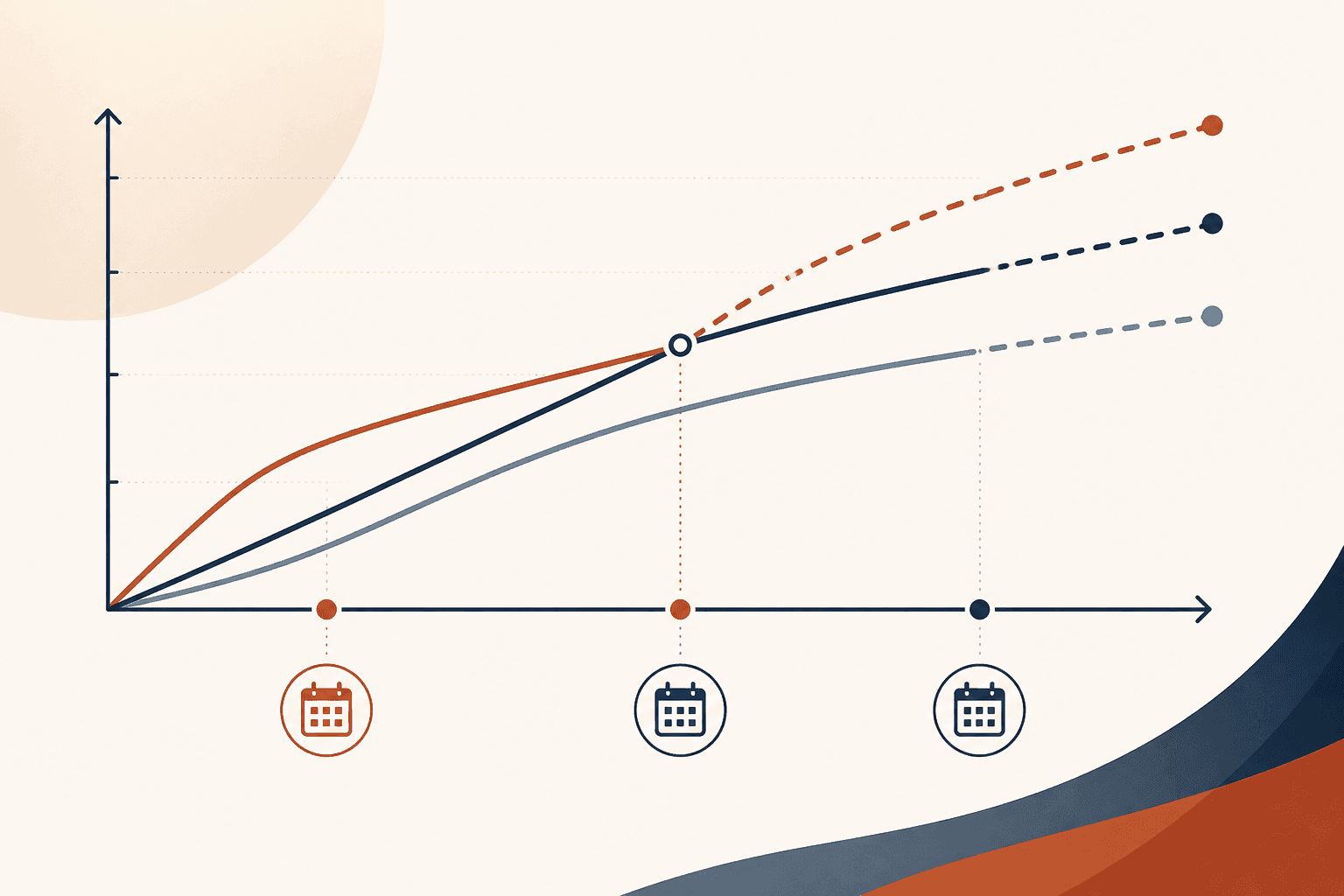
- In this hypothetical example, comparing claiming at 62 versus 67 puts your break-even age around 78 years, 8 months.
- Comparing 62 to 70 moves your break-even age to roughly 80 years, 4 months.
- The break-even number alone leaves out taxes, IRMAA brackets, and your spouse's survivor benefit.
- For couples with $2 million or more saved, your claiming decision fits inside a larger tax strategy, not a standalone calculation.
Your break-even age is the single number every Social Security calculator hands you. It looks like an answer.
It isn't. For a married couple, the claiming decision covers two lifespans, not one: yours, and your spouse's survivor benefit after you're gone.
The number itself is useful. On its own, it doesn't give you the full picture.
In this guide, you'll see:
- How to calculate your break-even age using a hypothetical married couple's numbers
- What the break-even number leaves out, including taxes, IRMAA, and survivor benefits
- How break-even analysis fits inside a tax-first retirement plan
- When the math points toward claiming early versus delaying
Let's get into it.
Table of Contents
What Social Security Break-Even Analysis Actually Tells You
Break-even analysis compares the total lifetime benefits of claiming at different ages. It finds the point where delaying overtakes claiming early.
The math itself is simple. Add up what you'd collect from age 62 to a given age. Compare that total to what you'd collect starting at 67 or 70 to the same age. The age where the delayed total crosses the early total is your break-even age.
For married couples, the calculation carries more weight. Each spouse has a separate earning record, and the higher earner's benefit sets the survivor benefit. That's what turns a single-lifespan calculation into a two-lifespan one.
Calculating Your Social Security Break-Even Age
Here's a hypothetical example. A married couple, both age 62. The primary earner's full retirement benefit at age 67 is $3,000 per month. Claiming at 62 reduces that to $2,100 per month. Delaying to 70 raises it to $3,720 per month.
Hypothetical example for illustration only. Results are not guaranteed and depend on individual circumstances.
The table below lays out what each claiming age produces in monthly and annual income, along with the cumulative total by two later ages.
| Claiming Age | Monthly Benefit | Annual Benefit | Cumulative by Age 80 | Cumulative by Age 85 | Break-Even vs. Age 62 |
|---|---|---|---|---|---|
| 62 | $2,100 | $25,200 | $453,600 | $579,600 | Baseline |
| 67 | $3,000 | $36,000 | $468,000 | $648,000 | 78 years, 8 months |
| 70 | $3,720 | $44,640 | $446,400 | $669,600 | 80 years, 4 months |
Comparing age 67 to age 70 on their own puts that break-even point at roughly 82 years, 6 months. Every year you live past your break-even age adds to the advantage of the later claiming age.
If you live past these ages, delaying pays off in cumulative benefits. If you don't, claiming early does.
What Break-Even Analysis Leaves Out
Break-even analysis is a math exercise. It compares benefit amounts and timing. It skips the factors that actually drive the claiming decision for couples with substantial retirement savings.
What the break-even number leaves out: your tax bracket and provisional income, Medicare IRMAA brackets, your spouse's survivor benefit, spousal benefit rules, Social Security's annual cost-of-living adjustment, and how long you'll actually live.
Taxes and Provisional Income
Social Security benefits may be taxable depending on your provisional income. That figure includes half your Social Security, your adjusted gross income, and any tax-exempt interest.
Claim early and draw from tax-deferred accounts to cover spending, and more of your benefit could land in taxable territory. Delaying Social Security and drawing from taxable accounts in the gap years may keep provisional income lower.
Read more about how provisional income works in Understanding Provisional Income and How It Affects Taxes on Your Social Security.
IRMAA and Medicare Premiums
Higher income in retirement can trigger IRMAA surcharges on Medicare Part B and Part D premiums. Claim early and take large withdrawals from tax-deferred accounts, and your modified adjusted gross income may spike.
That spike could push you into a higher IRMAA bracket. The surcharge adds hundreds, sometimes thousands, per year to your Medicare costs.
Read more in How to Avoid IRMAA Penalties: A Retiree's Guide to Medicare Savings.
Survivor Benefits
When one spouse dies, the survivor receives the higher of the two benefits, not both. The higher earner's claiming decision affects the survivor's income for the rest of their life.
Claim at 62, and the survivor could inherit a permanently reduced benefit. Delay to 70, and the survivor inherits the larger one.
Break-even analysis typically looks at one lifespan. For couples, the relevant question is how long the longer-living spouse will receive the survivor benefit. Read more in Maximizing Social Security for Couples: The Ultimate Guide to Dual Benefits.
Spousal Benefits
A spouse with a much lower earning record may receive a spousal benefit based on the higher earner's record. That benefit maxes out at the full retirement age amount, not the delayed one.
Delaying past full retirement age doesn't increase the spousal benefit, but it does increase the survivor benefit. Break-even analysis usually ignores this interaction.
Inflation and COLA Adjustments
Social Security receives annual cost-of-living adjustments. Larger monthly benefits get larger dollar increases from each one. Over 20 years of retirement, the gap between claiming at 62 and 70 widens with every adjustment.
Life Expectancy Uncertainty
Break-even analysis assumes you know your death date. You don't. A family history of longevity may push the calculation toward delaying; health issues may push it toward claiming early. The math gives you a number. It can't tell you which scenario applies to you.
How Break-Even Analysis Fits a Tax-First Retirement Plan
Break-even analysis alone is a math exercise. For couples with $2 million or more in retirement accounts, tax implications are what actually drive the claiming decision.
Your Social Security timing interacts with your Roth conversion strategy. Delay Social Security and live on taxable accounts or Roth conversions in the gap years, and you may create low-income years. Those years could be the ideal window to convert tax-deferred assets to Roth.
Claim early instead, and your income may run higher throughout retirement. Higher income means less room for Roth conversions and potentially higher IRMAA brackets, an effect break-even analysis doesn't capture.
A tax-first retirement plan treats the claiming decision as part of your whole income picture: tax brackets, Medicare premiums, required minimum distributions, and your spouse's survivor benefit. Break-even analysis is one input. It's not the answer.
Read more in Social Security Secrets: Claim at 62 or 70.
When Break-Even Analysis Points to Claiming Early vs. Delaying
Break-even analysis suggests claiming early if you expect to live shorter than your break-even age. Health concerns, family history, or immediate income needs may point that way.
Delaying makes more sense if you expect to live past the break-even age, especially for the higher-earning spouse. The survivor benefit argument is strongest when one spouse earned significantly more and the other is expected to live longer.
The decision is rarely that clean. A couple with $2.5 million in IRAs might find that delaying creates an ideal window for Roth conversions, and the tax savings could outweigh the break-even math. Another couple with the same savings might need the income now and have less flexibility.
The right claiming decision depends on your tax picture, your Medicare brackets, your spouse's life expectancy, and your income needs. Break-even analysis gives you one data point. A tax-aware retirement plan gives you a way to use it.
Putting Break-Even Analysis to Work
Your break-even age is a starting point, not an answer. It tells you where the math crosses over. It doesn't tell you what to do about your tax brackets, your IRMAA exposure, or your spouse's survivor benefit.
Those pieces connect. The year you claim Social Security could shape your Roth conversion window, which could shape your IRMAA bracket, which could shape what your spouse receives after you're gone. Looking at the claiming decision by itself misses how it moves the rest of your plan.
Retirement planning and tax planning built around your specific numbers can show you how those pieces move together, and where a break-even calculator's single number fits into that larger decision. The Retire Ready Roadmap™ walks through that process step by step. If you'd like to see how it applies to your situation, schedule a Strategy Session to start the conversation.
This content is for educational purposes only and is not investment, tax, or legal advice.