
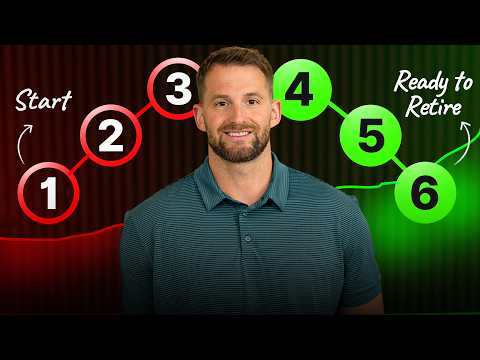
How to Build a TAX-PROOF Retirement Plan Starting at Age 55
If you are 55 or older, the tax decisions you make over the next several years may matter more to your retirement than any single investment choice you make. Most of the money sitting in your 401(k) or traditional IRA is not fully yours, it is yours and the IRS's, and the split between the two is largely determined by decisions made well before you actually retire.
The years leading up to retirement are often the best window you will ever have to influence that split. Income is typically at its most controllable point, tax brackets can be filled deliberately rather than accidentally, and there is still time to build tax diversification before required minimum distributions and Social Security start layering income on top of each other.
Here is what a tax-proof retirement plan looks like when you start building it at 55, and why waiting narrows your options.
Key takeaways:
Age 55 is typically early enough to build meaningful tax diversification before RMDs begin.
Roth conversions completed in lower-income years before retirement can reduce your lifetime tax bill.
Tax diversification across pretax, Roth, and taxable accounts gives you more control over your taxable income each year in retirement.
Waiting until RMDs force your hand often means paying taxes at a rate you did not choose, in a year you did not choose.
IRMAA surcharges on Medicare premiums are one more reason to plan your taxable income deliberately rather than by default.
Why Age 55 Is the Start of Your Best Tax-Planning Window
Once you retire, several sources of income start to overlap: Social Security, RMDs, pension income, and portfolio withdrawals. Each one adds to your taxable income, and by the time they are all active, you have far less ability to control which bracket you land in. At 55, that is not yet the case. If you are still working, or recently stopped, your income picture is simpler, and there is more room to make deliberate choices about how much taxable income to recognize in a given year.
This is exactly why the years between 55 and the start of RMDs are treated as a distinct planning phase rather than an extension of your working years. Decisions made in this window, particularly around Roth conversions, have more time to compound and more room to work with than the same decisions made five or ten years later.
Building Tax Diversification Before RMDs Force the Issue
If most of your retirement savings sits in pretax accounts, every withdrawal is taxed as ordinary income, and you have little control over the rate. Tax diversification means intentionally building balances across pretax, Roth, and taxable accounts so that, in retirement, you can choose which account to draw from based on your tax situation that year rather than being forced into one option.
For most households in their late 50s and early 60s, Roth conversions are the primary tool for building that diversification, since new Roth contributions are often limited by income or plan rules at this stage. Converting a deliberate amount each year, filling a target bracket without spilling into the next one, moves money from the taxable column to the tax-free column while you still have control over the pace. At MOKAN Wealth, we map this out year by year in the Rothification Method™ portion of your Retire Ready Roadmap™, so each conversion has a specific reason behind it.
Avoiding the RMD and IRMAA Trap Down the Road
Required minimum distributions are calculated from your pretax balance and are not optional once you reach RMD age, which means the size of your future RMDs is largely locked in by decisions made years earlier. A pretax balance left to grow unchecked from 55 to your early 70s can produce RMDs large enough to push you into a higher bracket, and to trigger IRMAA surcharges on your Medicare Part B and Part D premiums.
Reducing that future pretax balance through conversions completed between 55 and the start of RMDs is one of the most reliable ways to keep both your future tax bill and your Medicare premiums in check. The goal is not to eliminate your pretax balance entirely, it is to bring it down to a level that produces RMDs you can absorb without being pushed somewhere you do not want to be.
What does it mean to have a tax-proof retirement plan?
It means your retirement income is structured across pretax, Roth, and taxable accounts so you can control your taxable income each year in retirement rather than being forced into a tax outcome by RMDs or a single account type.
Why does starting at 55 matter instead of waiting until retirement?
Income is typically more controllable at 55 than it will be once Social Security, RMDs, and portfolio withdrawals are all active, which gives you more usable years to complete Roth conversions at a rate you choose.
What is tax diversification and why does it matter?
Tax diversification means holding savings across pretax, Roth, and taxable accounts so you have flexibility to choose which account to draw from based on your tax situation in a given year, rather than paying ordinary income tax on every withdrawal.
How do RMDs and IRMAA affect a retirement tax plan?
RMDs force taxable withdrawals from pretax accounts once you reach RMD age, and a large enough RMD can push your income high enough to trigger IRMAA surcharges on your Medicare premiums, which is why reducing your future pretax balance ahead of time matters.
Is it too late to start this planning if I am already 55 or older?
No. Fifty-five is generally considered an ideal starting point, since it typically leaves enough years before RMDs begin to complete a meaningful multi-year Roth conversion strategy.
This content is for educational purposes only and is not investment, tax, or legal advice.